
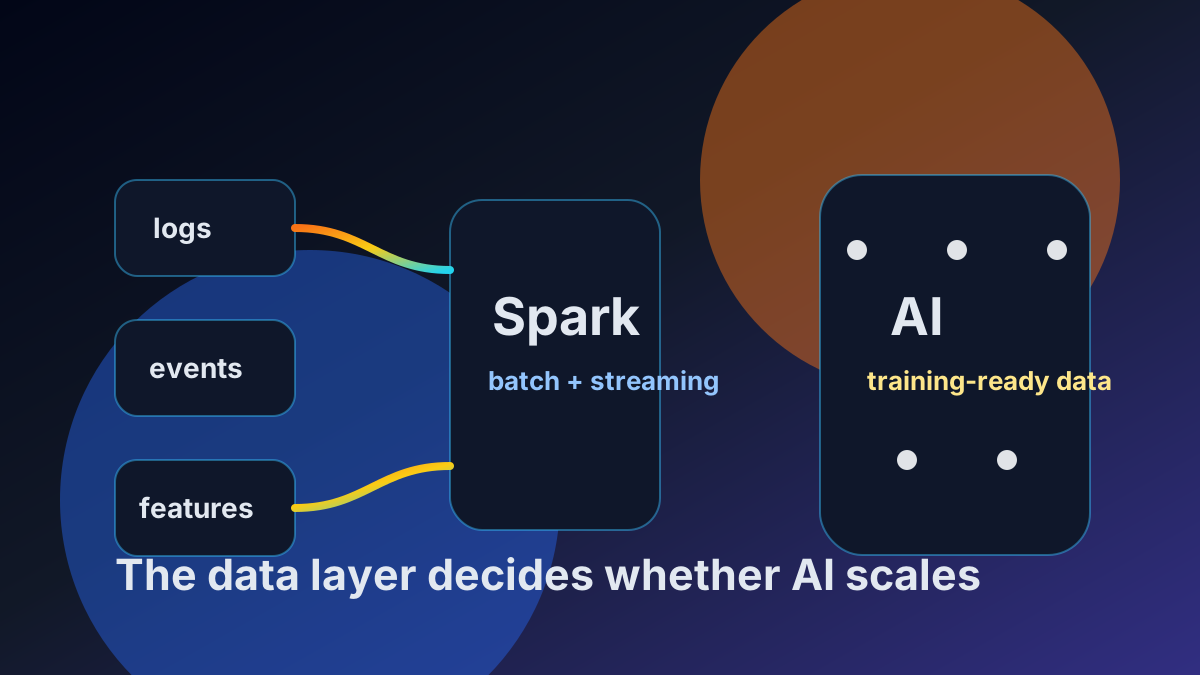
AI teams like to talk about models. Production systems are usually won or lost before the model sees a single batch.
The unglamorous layer is the data layer: joins, filters, deduplication, feature assembly, quality checks, sampling, backfills, evaluation splits, and scheduled refreshes. That is why Apache Spark still matters. It sits in the part of the stack where scale becomes real and where messy organisational data has to become something a model can learn from.
What the Spark 4.2 preview signals
A preview release is not a reason to rush production upgrades. It is a signal. Spark continues to move toward better distributed workflows, cleaner developer ergonomics, and stronger integration across notebooks, production jobs, remote execution, and large-scale SQL/DataFrame processing.
For AI teams, the point is not novelty. The point is less operational drag between an idea in a notebook and a job that can run reliably every day.
The model is not the pipeline
A model can be impressive in isolation and still fail in production because the input pipeline is fragile. If the training set cannot be reproduced, the evaluation set is contaminated, feature definitions drift between offline and online systems, or large joins spill unpredictably, the model story collapses.
Spark helps precisely because it treats data movement as a distributed systems problem. It gives teams a way to express transformations, inspect execution plans, manage partitions, handle skew, and push heavy work closer to the data.
Where AI teams should use Spark deliberately
Feature generation is the obvious place. If features depend on customer events, product telemetry, billing state, support interactions, or historical aggregates, Spark can build them reproducibly and at scale.
Training set assembly is the second. A good training dataset is not just a dump. It has point-in-time correctness, leakage controls, sampling discipline, label quality, and versioning. Spark jobs make those steps explicit instead of burying them in ad hoc scripts.
Evaluation is the third. Evaluation datasets need to be stable, representative, and refreshed on purpose. Spark can generate slices by geography, product line, customer type, time window, language, or risk category so teams can see where a model is strong and where it is merely lucky.
The operational traps to watch
Spark does not save bad architecture. Teams still have to manage small files, shuffle-heavy joins, skewed keys, serialization overhead, memory pressure, and expensive UDFs. They still need staging benchmarks before upgrades. They still need observability around runtime, input volume, failed tasks, spill, and output quality.
The difference is that Spark gives serious teams the handles to diagnose those problems instead of pretending that data preparation is just a Python script.
A practical upgrade mindset
Treat Spark upgrades as pipeline reviews, not version bumps. Pick the jobs that matter most. Capture baselines. Inspect physical plans. Benchmark representative data. Validate output checksums or row-level samples. Run backfills in staging. Confirm that downstream training code sees the same schema and semantics.
The payoff is boring in the best way: fewer surprises, clearer lineage, faster iteration, and less hero debugging at the moment the business needs a model retrained.
AI infrastructure is not only GPUs and model endpoints. It is the machinery that makes the right data arrive in the right shape at the right time. Spark remains one of the strongest tools for that job.